

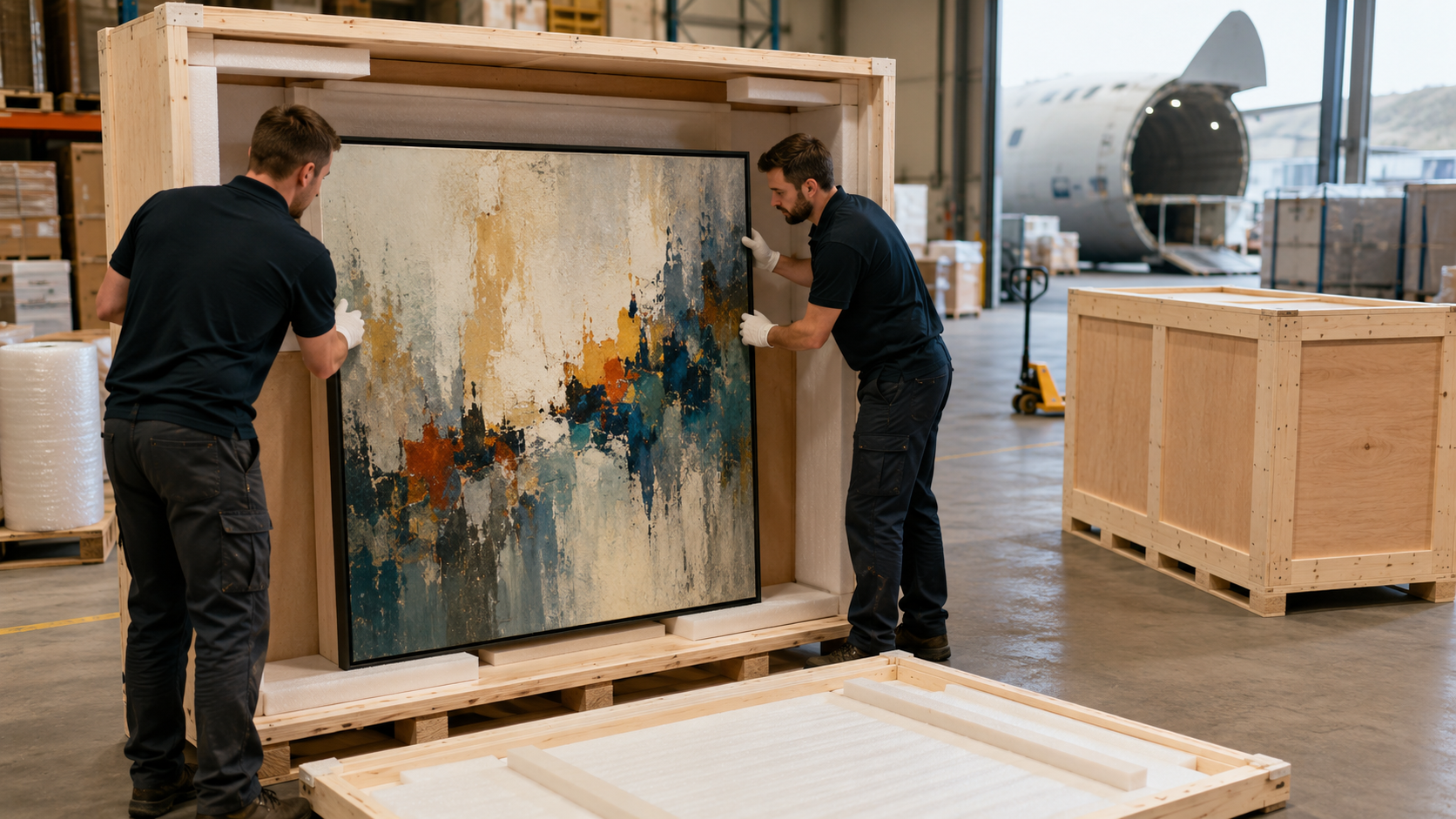
Shipping a valuable artwork is very different from sending an ordinary parcel.
Whether it is a painting purchased by an international collector, an exhibition piece travelling between galleries, a sculpture being delivered to a new owner, or an artwork being relocated with its owner, the shipment often combines high value, unusual dimensions and considerable fragility.
This is why fine art logistics requires more than simply arranging transport from one destination to another.
For artworks shipping internationally from South Africa, careful planning needs to take place long before the shipment reaches an airport, seaport or border. Packaging, handling, documentation, the chosen mode of transport and the final delivery all form part of the process.
Fine Art Logistics Is More Than Freight
International freight is ultimately about moving cargo between locations.
Fine art logistics adds another layer: ensuring that the artwork is appropriately protected and handled throughout that journey.
Unlike standard commercial cargo, artworks can present unusual challenges.
A large canvas may be relatively lightweight but extremely vulnerable to punctures, pressure and moisture. A sculpture may be heavy, irregularly shaped and difficult to secure. Framed works may contain glass, while older or particularly valuable pieces may require additional protection during handling and transport.
The financial value of the artwork can also be significant, but monetary value is not always the only consideration. Some works are unique and effectively impossible to replace.
This makes planning particularly important.
Before arranging an international shipment, factors such as the artwork’s dimensions, weight, construction, value, destination and required delivery date should all be considered.
Professional Packing and Crating
One of the most important parts of transporting fine art happens before the artwork leaves its original location.
It needs to be properly packed.
The appropriate packaging depends on the individual artwork and the journey it is about to undertake. A small framed work being transported by air may have very different requirements from a large sculpture travelling internationally.
Depending on the shipment, protection may include specialist wrapping materials, reinforced packaging, internal cushioning or a purpose-built wooden crate.
A properly designed crate does more than create a strong outer shell. It should help prevent the artwork from moving inside the packaging while providing protection against the knocks and vibration that can occur during handling and transport.
For particularly valuable, fragile or unusually shaped works, custom crating can therefore be an important part of the logistics process.
We’ve previously covered this subject in more detail in our guide to packing and crating artwork for international shipping.
Air Freight or Sea Freight for Artwork?
Another important decision is how the artwork should travel.
For international shipments from South Africa, air freight and sea freight can both be options depending on the artwork, destination, budget and timeframe.
Air Freight
Air freight is often the preferred option when delivery time is important.
The shorter transit time can also be attractive for valuable works because the artwork spends less time moving through the international logistics network.
However, faster transport normally comes at a higher cost, particularly when an artwork or its protective crate is large.
With air freight, the physical size of a shipment can have a significant effect on the freight cost even when the artwork itself is relatively light.
Sea Freight
Sea freight may be worth considering for larger shipments where delivery is less time-sensitive.
This can include substantial sculptures, collections consisting of multiple pieces or large crated artworks where air-freight costs become prohibitive.
The trade-off is a considerably longer journey.
The artwork therefore needs to be prepared and packed appropriately for the transport method and expected transit period.
There isn’t a single correct choice for every artwork. The most appropriate option needs to be determined according to the shipment itself.
Customs and Documentation
International art shipping also means crossing borders.
That introduces customs requirements and documentation that would not apply to a domestic shipment within South Africa.
Information about the artwork, its value, the exporter, the recipient and the reason for the shipment may be required as part of the export and import process.
The exact requirements can differ according to the destination country and the nature of the shipment.
For example, an artwork being permanently sold to an overseas buyer may be treated differently from a work temporarily travelling internationally for an exhibition before returning to South Africa.
Incorrect or incomplete documentation can result in delays while the shipment is already in transit.
It is therefore important to understand the requirements before the artwork leaves South Africa rather than trying to resolve documentation problems once it reaches another country’s border.
Insurance and Managing Risk
When transporting valuable artwork internationally, insurance should also form part of the planning process.
Freight moves through multiple stages.
The artwork may need to be collected, packed, transported to a freight facility, handled during export, loaded onto an aircraft or vessel, cleared at its destination and finally transported to the recipient.
Appropriate packaging and professional handling help reduce risk, but they cannot remove it completely.
Insurance requirements should therefore be considered according to the artwork’s value and the nature of the shipment.
It is also important to understand exactly what is covered, what documentation may be required and whether any conditions apply to packaging, valuations or handling.
This is particularly important for high-value works where ordinary freight liability may not provide the level of protection an owner expects.
The Importance of the Complete Journey
When people think about international shipping, it is easy to focus on the flight or sea voyage.
In reality, this is only one part of the artwork’s journey.
A shipment from South Africa to an overseas collector, for example, may involve:
- Collection from the artist, gallery or owner
- Specialist packing or crating
- Transport to the freight facility
- Export documentation and customs processes
- International air or sea freight
- Import clearance at the destination
- Local transport
- Final delivery to the collector, gallery or other recipient
Each stage needs to work with the next.
This is one of the reasons that using the cheapest available freight rate does not necessarily mean achieving the best overall solution.
The objective is not simply to get the crate onto an aircraft or vessel. It is to get the artwork safely from its original location to its final destination.
Choosing a Fine Art Logistics Provider in South Africa
If you’re planning to ship artwork internationally, it helps to work with a logistics provider that understands the requirements associated with valuable and fragile cargo.
Before arranging the shipment, provide as much information as possible.
This should ideally include:
- The type of artwork
- Dimensions
- Weight
- Whether it is already professionally packed
- Approximate value
- Collection location
- International destination
- Required delivery timeframe
- Any unusual handling requirements
Photographs can also be useful, particularly for sculptures, unusually shaped artworks or items that still need to be packed.
The more information available at the planning stage, the easier it becomes to determine the appropriate packaging and transport solution.
Shipping Fine Art Internationally from South Africa
South African artists, galleries, collectors and private owners increasingly operate in an international market.
An artwork sold in Cape Town or Johannesburg may ultimately be destined for a collector thousands of kilometres away.
Getting it there requires more than simply booking international freight.
The artwork needs to be assessed, appropriately packed, transported using a suitable freight method and accompanied by the correct documentation.
That is where specialist fine art logistics becomes important.
At Calco Cargo, we assist clients with international freight solutions for artworks and other valuable or fragile shipments from South Africa.
If you are planning an international art shipment, speak to us before arranging the transport. Provide us with the details of the artwork, its dimensions, collection location and destination, and we can help you determine the most appropriate way forward.